3F,Block C,No.179 Guangpu East Road, Huangpu District, Guangzhou, GD, China
Views: 120 Author: Site Editor Publish Time: 2025-02-26 Origin: Site


Another major new discovery of BDD diamond
Scientists have discovered the plasmon effect in boron-doped diamond for the first time, opening up a new path for quantum information technology!
Recently, a breakthrough study was published in the journal Nature Communications. Scientists discovered a new characteristic-the plasmon effect in boron-doped diamond (BDD) for the first time. This discovery not only reveals the profound impact of boron doping on the electronic structure of diamond, but also provides new possibilities for the development of quantum information technology.

As a wide-bandgap semiconductor, diamond has attracted much attention due to its excellent thermal conductivity, high breakdown electric field, and high carrier mobility at room temperature. By doping it with boron, diamond can exhibit metal-like properties and even become superconducting in some cases. However, previous research on boron-doped diamond mainly focused on electronic conductivity, while relatively little research on its optical properties has been conducted.
In this study, the research team successfully detected low-energy excitations in boron-doped diamond using scanning transmission electron microscopy-valence electron energy loss spectroscopy (STEM-VEELS) and near-field infrared spectroscopy. Through first-principles calculations, they found that these low-energy excitations originate from electronic transitions between valence bands, known as inter-valence band plasmas. The presence of this plasma causes diamond to exhibit metal-like properties at infrared frequencies.
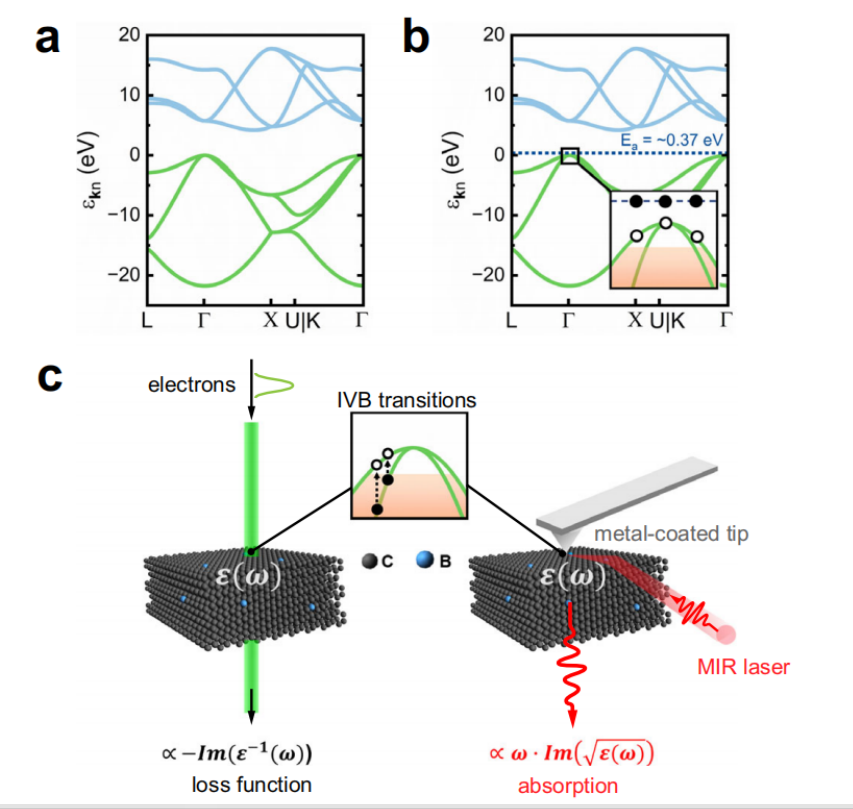
The research team also found that as the boron doping concentration increases, the frequency of the inter-valence band plasma blue-shifts and its intensity also increases. This phenomenon shows that the inter-valence band plasmon in boron-doped diamond is tunable and provides new ideas for the future design of semiconductor-based plasmonic materials.
In addition, as a key material for quantum information technology, diamond’s internal point defects (such as color centers) have quantum emission properties. By doping with boron, not only can the charge state of these point defects be controlled, but also their photoluminescence and emission rates can be enhanced using plasmon excitation. This provides new ways to develop new quantum emitters and optimize the performance of quantum devices.
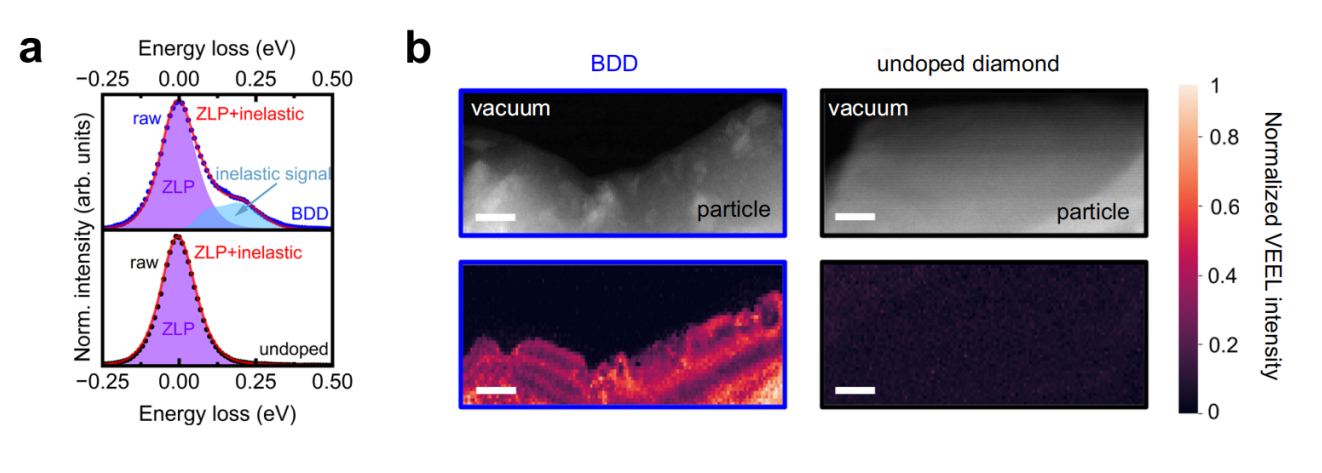
This research was completed in collaboration with multiple research institutions including the University of Illinois at Urbana-Champaign, the University of Luxembourg, and the University of Aix-Marseille in France, and was supported by the National Science Foundation and other institutions. The research team stated that in the future, they will further explore how to precisely control the nanoscale concentration of boron doping to optimize the optical and spin properties of diamond. This discovery not only deepens our understanding of electronic transitions in doped semiconductors, but also opens up new research directions for the development of quantum information technology and nanophotonics.
The discovery of interband plasmons in boron-doped diamond marks an important step for scientists in exploring new quantum materials. With the deepening of research, this discovery is expected to bring revolutionary breakthroughs in fields such as quantum computing and quantum communications.
References:
Nature Communications, Intervalence plasmons in boron-doped diamond, 14 January, 2025.